
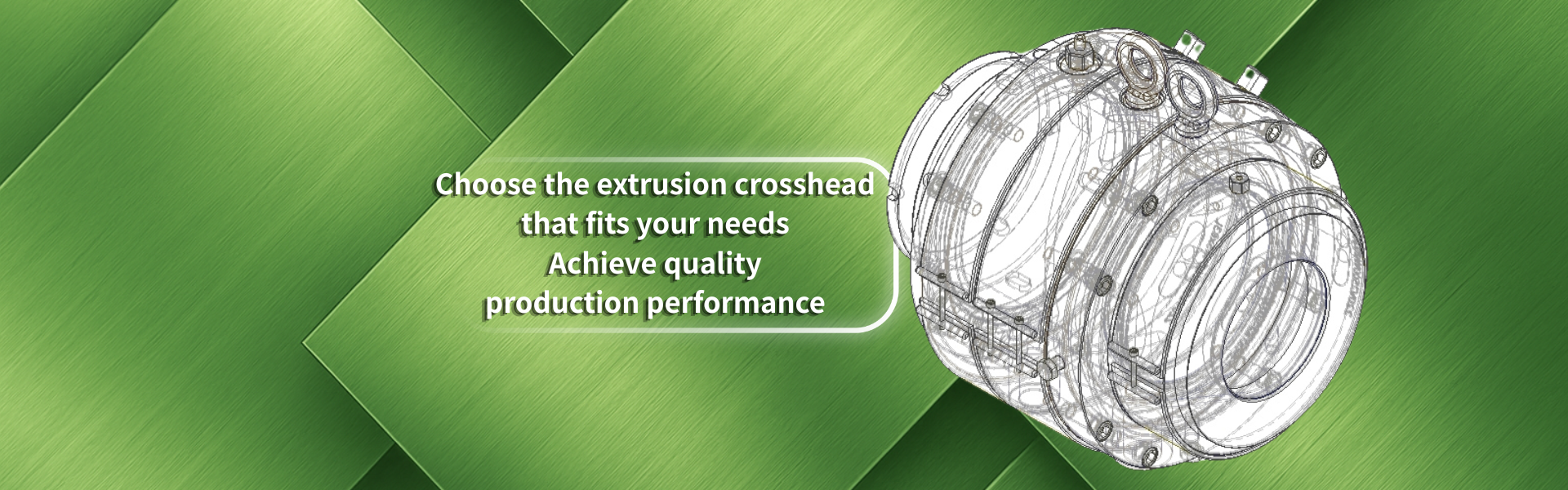
Extrusion Crossheads: How They Work, Types, and Custom Builds
Every insulated wire, jacketed cable, and coated core on an extrusion line passes through a crosshead. The crosshead decides how evenly the melt reaches the product, how concentric the wall is, and how long a changeover takes. This page explains what an extrusion crosshead does, the main crosshead types, how to choose between them, and what to send us when you need one built.
SPiDER EXTRUSION has manufactured standard and customized extrusion crossheads and extrusion tooling since 1988, and we make spare parts for extrusion crossheads. Prototyping, design, construction, and testing all happen in our own facility in Taiwan.
What Is an Extrusion Crosshead?
An extrusion crosshead (also written cross head, and also called a crosshead die or extruder crosshead) is the head that sits between the extruder and the product when the product must pass through the head. The extruder pushes melt into the side of the crosshead. Inside, the flow turns, divides around a central core tube, and joins again as a uniform ring. The conductor, cable core, or tube enters at the back of the crosshead, travels along its center line, and leaves through the tip and die with the new layer around it.
Crosshead extrusion is the process of applying plastic this way. It is used for wire insulation, cable jacketing and sheathing, multi-layer cable constructions, coating a pipe or other continuous substrate, and some tube and hose lines.
Crosshead vs straight (inline) head
A crosshead is side-fed. A straight die, also called an inline head, is front-fed: the melt flows straight from the extruder through the die. A straight die is the usual choice for single-layer tubes and profiles with nothing running through the middle. A crosshead is the choice when a conductor or core must be coated, or when several layers must be combined in one head. Our plastic extrusion head selection guide compares crossheads, straight dies, T-dies, and profile dies by product shape.
How a Crosshead Works: The Melt Path
Most wire and cable crossheads have the same functional parts, even when the internal flow channels differ by design:
- Extruder connection. The crosshead mounts to the extruder through a flange or adapter, held by a clamp. A breaker plate and screen pack sit at this joint to filter the melt and build back pressure.
- Crosshead body. The heated body receives the melt from the side and carries it to the distributor. Heater bands keep the body at process temperature.
- Distributor (core tube or flow diverter). The distributor splits the side-fed melt and spreads it around the core so that it arrives at the front as an even ring, without a weak weld line on one side. The quality of this flow channel decides how uniform the wall is.
- Tip (guider). The tip guides the conductor or core through the center of the head and forms the inside of the melt ring.
- Die. The die forms the outside of the melt ring and sets the final outside diameter together with draw-down and die swell.
- Centering. The tip and die must be concentric for an even wall. In a fixed-center crosshead the machined fit sets the centering. In an adjustable crosshead the operator moves the die with centering bolts.
Pressure tooling vs tubing tooling
The same crosshead can run different tip-and-die set-ups. With pressure tooling, the tip stops short of the die land, so the melt meets the conductor inside the die under pressure. This fills the gaps between strands and gives good adhesion, and it is common for primary wire insulation. With tubing tooling, the tip extends to the die face, so the melt leaves the die as a tube and is drawn down onto the core outside the die, often with vacuum. This is common for jackets and sheaths that must strip easily. Semi-pressure tooling sits between the two. The choice changes the tip and die design, not the crosshead body.
Types of Extrusion Crossheads
Crossheads are grouped in two ways: by how the tip and die are centered, and by how many layers or stripes the head applies. Most heads combine one choice from each group, and every SPiDER EXTRUSION crosshead below can be customized.
Fixed-center (self-centering) crossheads
In a fixed-center crosshead, the position of the tip and die is fixed by the design, so the operator does not adjust centering. This makes set-up repeatable and suits long runs of one product specification, small cables, and ultra-thin insulation, where a small centering error is a large share of the wall. Some of our fixed-center designs add manual micro-adjustment for very thin walls. Our fixed-center heads hold concentricity to ±0.02 mm and set up in 15–30 minutes. The standard model is listed in the range table below.
Adjustable crossheads
In an adjustable crosshead, centering bolts move the die relative to the tip, so the operator can correct wall-thickness variation while the line runs. Adjustable crossheads suit plants that run many product sizes on one line. Centering travel is about ±5 mm, which covers about 80% of common product sizes. They need more operator skill than fixed-center heads. Read the full fixed-center vs adjustable crosshead comparison before you decide.
Single-layer and multi-layer (co-extrusion) crossheads
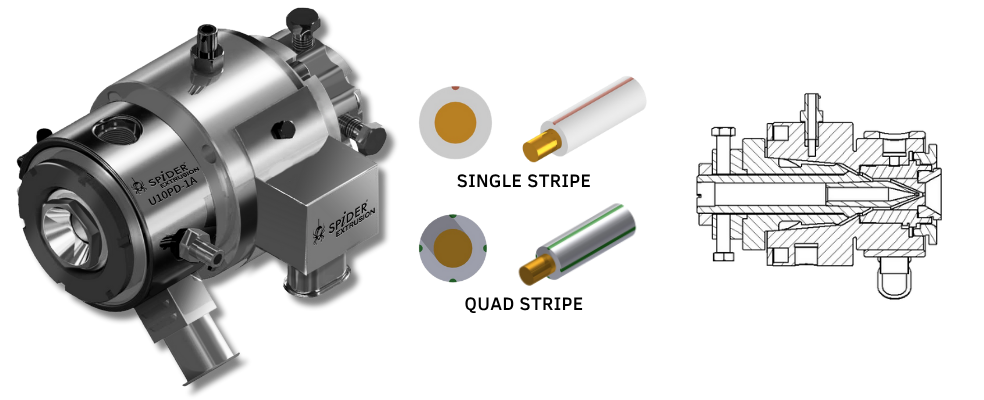
A single-layer crosshead applies one material. A multi-layer crosshead has one distributor per layer and joins the layers inside the head, so a cable can receive, for example, an insulation layer and a skin layer in one pass. Our two-distributor extrusion die head uses a fixed centering system for high concentricity on small cables and thin insulation, and our double-layer extruder head covers co-extrusion of two layers.
Striping crossheads
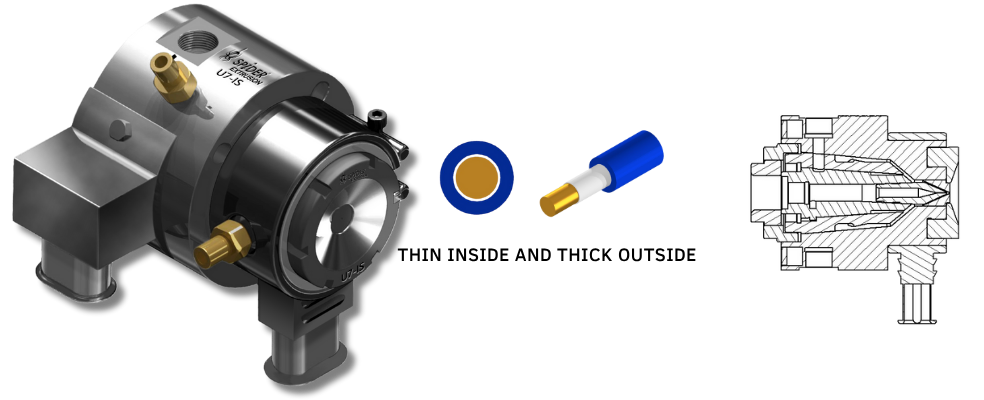
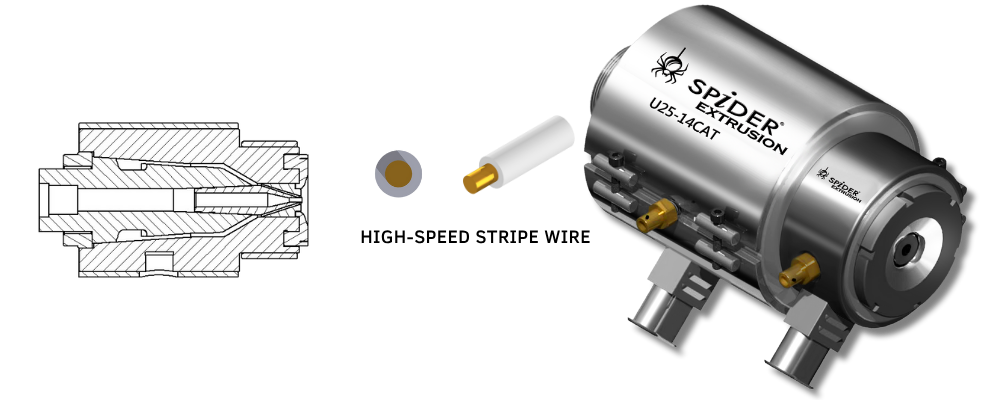
A striping crosshead adds one or more color stripes to the insulation for wire identification. A second, small extruder feeds the stripe material into the head. We build high-speed striping crossheads for high-capacity wire lines.
Large crossheads
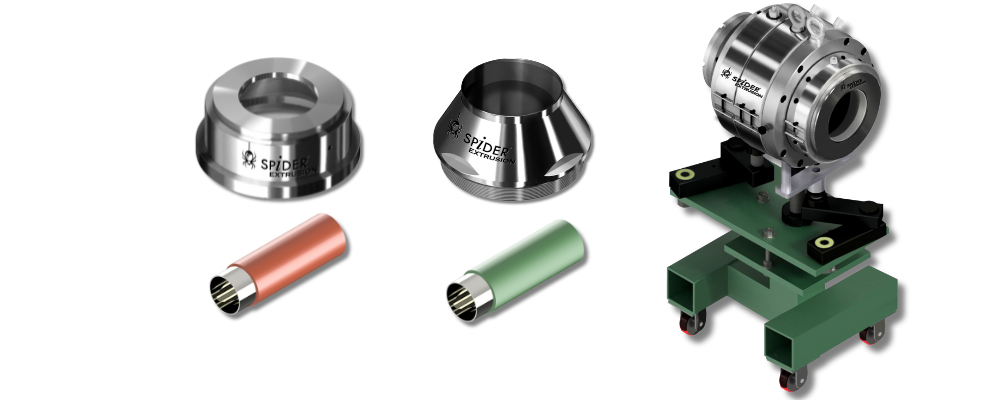
Large crossheads are built for high-volume, high-pressure work such as large-diameter plastic pipes, industrial hoses, construction conduits, and multi-layer co-extrusion. The flow channel and the centering system must keep the melt even around a much larger circumference. We build large crossheads in single-layer, dual-layer, and co-extrusion versions.
Tube and pipe crossheads
Tube and pipe heads must hold wall thickness and roundness over many diameters. Our extrusion pipe heads serve plastic and PVC pipe lines for water supply, cable conduit, medical tubing, and construction piping, in mono-layer, dual-layer, and co-extrusion versions. Our tube extrusion process guide explains when a tube line needs an inline head and when it needs a crosshead.
Flat, shape, and micropearl crossheads
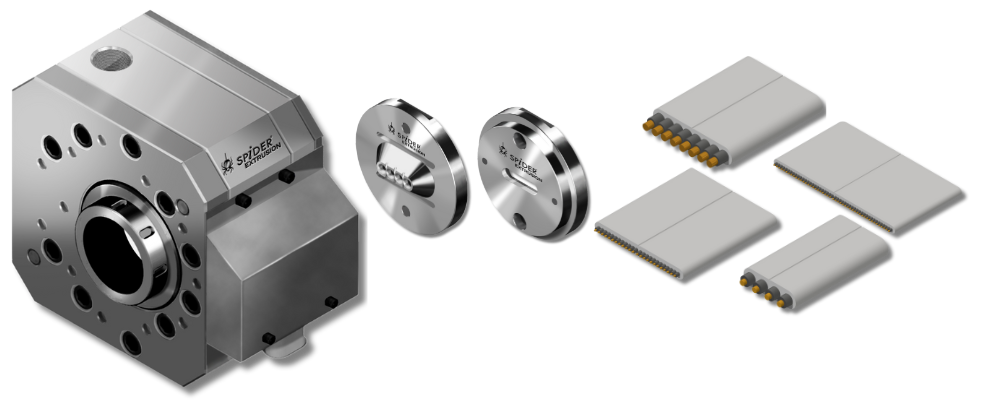
Not every crosshead product is round. Flat crossheads coat strip and flat profiles, and shape extrusion crossheads make complex profiles, with the flow channel matched to the product drawing. For microbead production we build a plastic micropearl extrusion crosshead.
SPiDER EXTRUSION Crosshead Range at a Glance
| Crosshead type | Built for | Centering | Product page |
|---|---|---|---|
| Fixed-center crosshead | Single-specification runs, small cables, multi-core wire, thin insulation | Fixed | Fixed-center extrusion head |
| Adjustable crosshead | Many product sizes on one line | Adjustable (centering bolts) | Adjustable extruder crosshead |
| Two-distributor crosshead | Dual-layer insulation, fine-tuned concentricity on small cables | Fixed, with manual micro-adjustment | Two-distributor extrusion die head |
| Double-layer extruder head | Two-layer co-extrusion | By design | Double-layer extruder head |
| High-speed striping crosshead | High-capacity wire lines with color stripes | Per design | On request |
| Large crosshead | Large-diameter pipe, industrial hose, conduit, multi-layer | By design | On request |
| Tube and pipe head | Plastic and PVC pipe and tube, mono-layer to co-extrusion | By design | Extrusion pipe heads |
| Shape and flat crosshead | Complex profiles, strip, and flat products | By design | Shape extrusion crosshead |
| Micropearl crosshead | Microbead production | By design | Micropearl extrusion crosshead |
How to Choose an Extrusion Crosshead
Start from the product, not the head. Answer these questions in order:
- What passes through the head? A solid or stranded conductor, a multi-core cable, a tube, or a flat strip. This sets the tip design and the size range of the head.
- How many layers and stripes? One layer, a skin layer, two distributors, or color stripes. Each layer needs its own melt feed and flow channel.
- Which materials? Name each insulation and jacket compound. Heat-sensitive compounds need short, streamlined flow paths with no dead spots.
- How many product sizes, and how often do you change over? One product for long runs points to a fixed-center crosshead. Many sizes and frequent changes point to an adjustable crosshead.
- Who runs the line? Adjustable centering rewards an experienced operator. Fixed-center heads reduce dependence on operator skill.
- Pressure or tubing tooling? Decide whether the melt must meet the conductor inside the die (pressure) or be drawn down outside it (tubing).
- What must it fit? The extruder size, the flange or adapter, the line speed, and any existing tips and dies you want to keep using.
Common crosshead problems that point back to the head
Uneven wall thickness usually means centering, a worn tip or die, or an unbalanced flow channel. Rough or sharkskin surfaces can come from melt fracture at the die exit. Black specks and color streaks often come from degraded material held in a dead spot, which is a cleaning and flow-design issue. A blocked or damaged screen pack at the breaker plate shows up as pressure changes before it shows up in the product.
What to Send Us for a Crosshead Quote
A custom crosshead is designed around your product. The more of this information you send, the faster our engineers can answer:
- Product drawing or cross-section, with conductor or core size and finished outside diameter
- Number of layers and stripes, and the wall thickness of each
- Materials for each layer
- Extruder size and the connection (flange or adapter) the head must fit
- Target line speed and output
- Fixed-center or adjustable preference
Why Engineers Source Crossheads from SPiDER EXTRUSION
- Since 1988. We have specialized in extrusion tooling manufacturing for the cable and wire industry since 1988. About SPiDER EXTRUSION.
- 300+ production lines. We have supported more than 300 production lines. Across them, fixed-center crossheads show on average a 30% lower defect rate than adjustable models.
- Thousands of tips and dies. We have developed extrusion tips and dies from simple single-conductor designs to multi-conductor, multi-layer, multi-stripe, and special-shape constructions.
- Replacement tooling for other heads. We supply replacement tools for most OEM and ODM extrusion heads, and spare parts for extrusion crossheads.
- In-house manufacturing. Prototyping, design, construction, and testing happen in our own facility. Our workshop does micro-turning and turning, 4-axis CNC milling, surface grinding and polishing, steel and tungsten carbide machining, EDM, and custom laser marking.
- Custom by default. Every crosshead type on this page can be customized, and we design new heads to your specification. See the industries we serve and our wider extrusion tooling range.
- After-sales technical support. We support customers after delivery, from set-up questions to replacement tooling.
Crosshead Care and Maintenance
A crosshead stays accurate only if its flow surfaces stay clean and undamaged. Purge before shutdown, take the tip and die out while the head is still at temperature, clean flow surfaces only with soft tools such as brass, and never scrape them with steel. Inspect the tip end, the die land, and the centering threads at every cleaning, and replace worn tips and dies before they cause wall-thickness drift. For the full procedure, see how to clean and disassemble an extrusion crosshead.
Frequently Asked Questions
What is an extrusion crosshead?
An extrusion crosshead is an extrusion head that receives melt from the side and distributes it into an even ring around a wire, cable core, tube, or other substrate that passes through the center of the head. The tip and die at the front form the final coating or wall.
What is the difference between a crosshead and a straight die?
A crosshead is side-fed, so a conductor or core can pass straight through it and be coated. A straight (inline) die is front-fed and is normally used for single-layer tubes and profiles with nothing passing through the middle.
Should I choose a fixed-center or an adjustable crosshead?
Choose a fixed-center crosshead for long runs of one specification, small cables, and thin insulation, where repeatable centering matters most. Choose an adjustable crosshead when one line must run many product sizes and an experienced operator can set the centering.
What is the difference between pressure tooling and tubing tooling?
With pressure tooling the melt meets the conductor inside the die under pressure, which gives good fill and adhesion. With tubing tooling the melt leaves the die as a tube and is drawn down onto the core outside the die, which gives a jacket that strips easily.
Can SPiDER EXTRUSION make tooling for a crosshead from another manufacturer?
Yes. We supply replacement tools for most OEM and ODM extrusion heads. Send the head model and a drawing or sample of the current tip and die.
What information do you need to quote a custom crosshead?
A product drawing or cross-section, conductor or core size, finished diameter, number of layers and stripes, materials, extruder size and connection, target line speed, and whether you prefer fixed-center or adjustable centering.
Need a Crosshead Built to Your Line?
Send your product drawing and line details. Our engineers in Taiwan will reply with a design proposal and quote.