
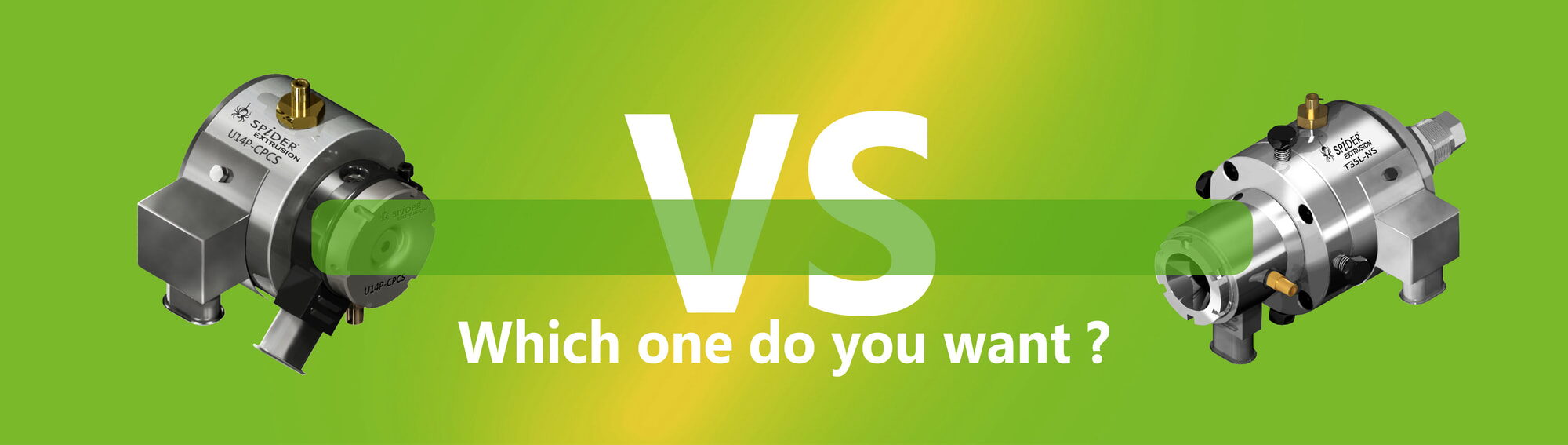
Adjustable vs Fixed Extruder Crosshead: How to Choose
All extrusion crossheads have to center the tip inside the die, because the gap between them sets the wall thickness around the wire or core. There are two ways to do it. An adjustable extruder crosshead lets the operator move the die. A fixed center extruder crosshead builds the centering into the design. The choice affects setup, the skill your line needs, and how consistent the wall is from run to run. Die geometry also drives flow defects, which we cover in our guides to melt fracture causes and fixes and die swell. This guide from SPiDER EXTRUSION compares the two designs and shows which one fits your line.
Contact us to get a customized solution
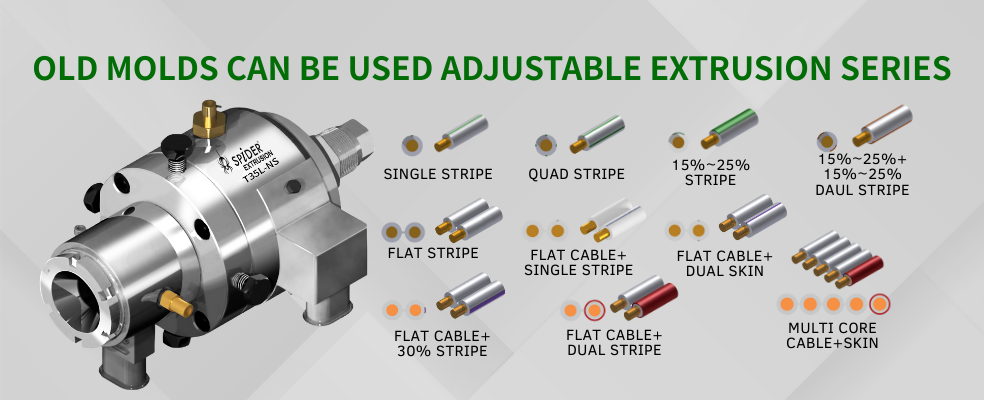
Adjustable Extruder Crosshead
In an adjustable extruder crosshead, centering bolts move the die relative to the tip. The operator can set the centering for each product and correct wall-thickness variation while the line runs. This suits plants that run many product sizes on one line and change over often.
- How centering works: centering bolts move the die relative to the tip.
- Best fit: many product sizes and frequent changeovers on one line.
- Correction during the run: yes, the operator can adjust the wall while the line runs.
- Trade-off: results depend on operator skill, and a new tip and die set needs centering again.
- Centering travel: about ±5 mm, which covers about 80% of common product sizes. This is how far the die can move around the tip. The cable diameter itself depends on the tip and die set.
- Learning curve: about 6 months for an operator to run it reliably.
- Range in practice: SPiDER EXTRUSION has supplied an adjustable crosshead to a military cable manufacturer that needed diameters from 0.5 mm to 50 mm from one set of equipment.
Fixed Center Extruder Crosshead
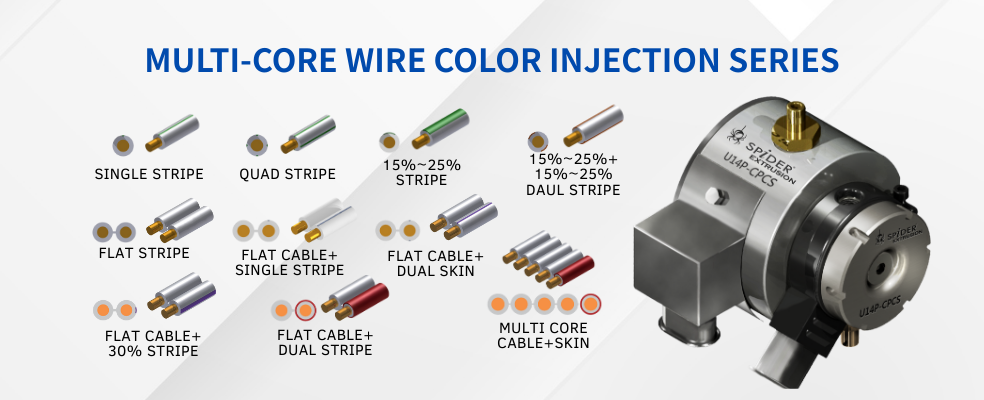
In a fixed center extruder crosshead, also called a self-centering crosshead, the position of the tip and die is fixed by the design. The operator does not adjust centering, so setup is repeatable. This suits long runs of one product specification, small cables, and ultra-thin insulation, where a small centering error is a large share of the wall. Some SPiDER EXTRUSION fixed center designs add manual micro-adjustment for very thin walls.
- How centering works: the design and the machined tooling hold the tip and die in position.
- Best fit: long runs of one specification, small cables, and thin insulation.
- Operator skill: lower, because there is no centering step at setup.
- Trade-off: less freedom to correct the wall during the run.
- Concentricity: ±0.02 mm.
- Setup time: 15–30 minutes, about 70% faster than adjustable models.
- Learning curve: about one day. No skilled operator is required.
- Maintenance and cleaning time: 50% less than conventional designs.
- Radial flow uniformity: variation under 2%.
- Field record: across more than 300 production lines SPiDER EXTRUSION has supported, fixed center crossheads show on average a 30% lower defect rate than adjustable models.
Side-by-Side Comparison
| Adjustable crosshead | Fixed center crosshead | |
|---|---|---|
| Centering | Set by the operator with centering bolts | Fixed by the design |
| Correction while running | Yes | No (micro-adjustment on some designs) |
| Setup | Centering step for each tooling set | Repeatable, no centering step |
| Centering range and precision | About ±5 mm of travel | ±0.02 mm concentricity |
| Setup time | Centering step for each tooling set | 15–30 minutes |
| Operator skill | Higher | Lower |
| Learning curve | About 6 months | About one day |
| Best fit | Many sizes, frequent changeovers | Long runs of one specification, small cables, thin insulation |
How to Choose
- How many product sizes, and how often do you change over? One product for long runs points to a fixed center crosshead. Many sizes and frequent changes point to an adjustable crosshead.
- How thin is the wall? Small cables and ultra-thin insulation favor fixed center, where a small centering error is a large share of the wall.
- Who runs the line? Adjustable centering rewards an experienced operator. Fixed center heads reduce dependence on operator skill.
Both crosshead types are one part of the tooling stack. See our complete guide to extrusion tools for how dies, crossheads, and breaker plates work together, our breaker plate guide for how melt is stabilized before it reaches the crosshead, and how to clean an extrusion crosshead to keep either type accurate.
Other blog posts
SPiDER EXTRUSION Joins HANNOVER MESSE 2025 for the First Time
SPiDER EXTRUSION Representing at HANNOVER MESSE 2025 …

What Is a Breaker Plate? Complete Guide for Extrusion Beginners
Discover how breaker plate in extrusion improves melt consistency, why breaker plate for extruder enhances control….
PVC vs XLPE Cable Insulation: Pros and Cons Explained
In the cable manufacturing industry, one question never seems to go away: PVC vs XLPE cable…
Our Products
Quality Extrusion crosshead, Extrusion tooling, Extrusion Accessories
Frequently Asked Questions
What is the difference between an adjustable and a fixed center extruder crosshead?
In an adjustable crosshead, centering bolts move the die relative to the tip, so the operator can correct wall-thickness variation while the line runs. In a fixed center crosshead, the position of the tip and die is fixed by the design, so the operator does not adjust centering and setup is repeatable.
Which crosshead type gives more repeatable setup?
The fixed center crosshead. Centering comes from the design and the machined tooling, not from an operator setting, so each setup starts from the same position. This matters most for small cables and ultra-thin insulation, where a small centering error is a large share of the wall.
Which crosshead type needs more operator skill?
The adjustable crosshead. The operator sets the centering and corrects it during the run, so results depend on experience. A fixed center crosshead reduces dependence on operator skill.
Which crosshead is better for running many cable diameters on one line?
The adjustable extruder crosshead. When one line runs many product sizes with frequent changeovers, the operator can center each new tip and die set on the line and correct the wall while it runs.
Does SPiDER EXTRUSION make both crosshead types?
Yes. SPiDER EXTRUSION has designed and built extrusion crossheads and tooling since 1988, including adjustable and fixed center crossheads, and every design can be customized. We also supply replacement tips and dies for most OEM and ODM heads.
Contact SPiDER EXTRUSION today for a custom extrusion crosshead!